
Introduction
Training large language models (LLMs) requires enormous amounts of computing power and memory. As models grow to billions or even trillions of parameters, a single GPU may not have enough resources to train them efficiently. LLM parallelism allows organizations to distribute model training across multiple GPUs or servers.
Three important approaches are data parallelism, tensor parallelism, and pipeline parallelism. Each method distributes work differently, and understanding their differences can help businesses design efficient AI infrastructure.
What Is LLM Parallelism?
LLM parallelism involves dividing training or computation across multiple GPUs. Instead of asking one GPU to handle the entire workload, multiple devices work together. The most suitable approach depends on model size, available hardware, networking, and training requirements.
1. Data Parallelism
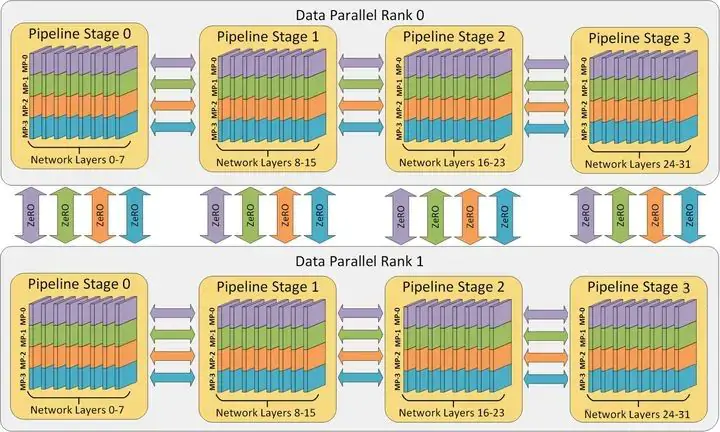
Data parallelism is one of the most straightforward approaches. In data parallel training, each GPU maintains a copy of the model while processing a different portion of the training data. After processing their respective batches, the GPUs communicate to synchronize model updates.
Simple scaling:
Multiple GPUs can process different data batches simultaneously.
Higher throughput:
More training examples can be processed at the same time.
Useful for large datasets:
Data can be divided across multiple workers.
However, every GPU needs to hold the model, which can become a problem when the model is too large to fit into a single GPU’s memory.
2. Tensor Parallelism
Tensor parallelism divides individual model operations across multiple GPUs. Instead of placing the entire model on every GPU, parts of large computations are distributed between devices. For example, different GPUs may handle portions of a matrix multiplication. This approach can allow models that exceed the memory capacity of a single GPU to be processed across multiple devices.
Tensor parallelism requires frequent communication between GPUs. As a result, high-bandwidth, low-latency interconnects are important. Technologies such as NVIDIA NVLink can help support fast communication within compatible GPU systems, while high-performance networking can connect GPUs across nodes.
3. Pipeline Parallelism
Pipeline parallelism divides the model into different layers or groups of layers. Each GPU is responsible for a particular section of the model. For example, the first group of GPUs could process the early layers, while later GPUs handle subsequent layers. Training data moves through these stages in sequence.
Pipeline parallelism can distribute a very large model across multiple GPUs without requiring every GPU to store the complete model. However, poor pipeline scheduling can create idle periods, sometimes called pipeline bubbles. Careful configuration and micro-batching can help reduce this inefficiency.
Why Networking Matters
As more GPUs participate in training, communication becomes increasingly important. GPUs need to exchange gradients, activations, and other information. Slow networking can create bottlenecks and reduce the benefits of adding additional GPUs.
Therefore, large LLM clusters often require high-speed networking and efficient communication libraries to achieve good scaling.
Conclusion
For smaller models, data parallelism may be sufficient. Larger models may require tensor or pipeline parallelism, while extremely large workloads can combine all three approaches.
By selecting the right parallelism strategy and supporting it with suitable GPUs, memory, networking, and software, organizations can build infrastructure capable of training increasingly sophisticated LLMs efficiently.
